


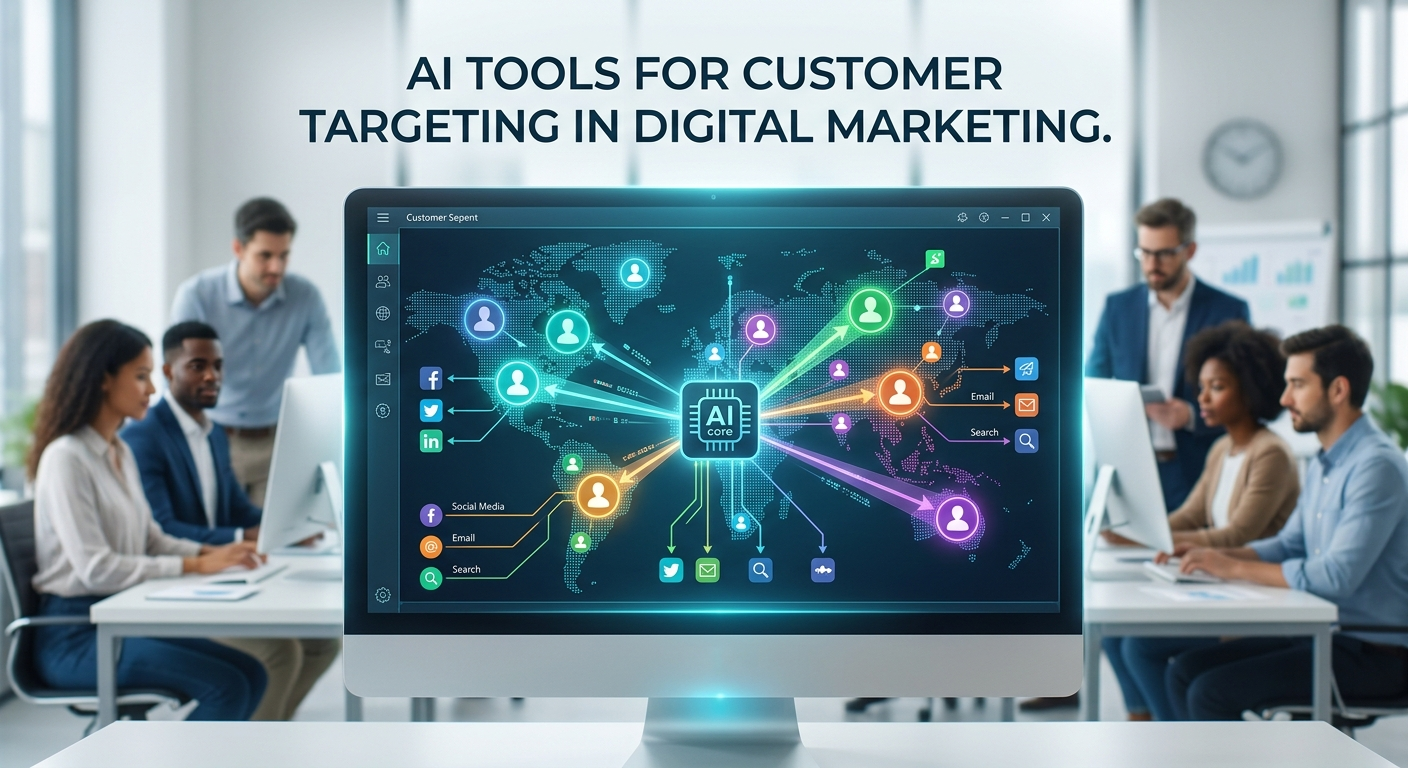
Here’s a bold statement: AI can make your targeting smarter than your competitors’ if you know what to use and how. This guide talks about Ai tools for customer targeting in digital marketing and why they are important for relevance, personalisation and efficiency. We’ll explore critical capabilities, real-world use cases, and best practices for integration. Read on for a practical playbook to higher CTRs, lower CPAs, and sustainable growth.
How To Use AI Tools To Pinpoint Perfect Customers Online
Begin by training AI on what “perfect” looks like for your brand: mine reviews, chat logs and call transcripts, then extract jobs-to-be-done, worries and switching triggers using language models and turn it into a compact “customer fingerprint.” Turn that fingerprint into embeddings, cluster it against social posts, subreddit threads, Discord chats, and even TikTok sound patterns to reveal non-obvious lookalike pockets – affinity groups you’d miss with demographics alone. You’ll see patterns like problem language, seasonal indications, or creator ecosystems that connect with high-intent occasions.
Activate using uplift modelling so you target the persuadable, not just the likely-to-buy, and deliver those signals into ad platforms via server side conversion APIs or clean rooms to keep privacy-safe. Have generative models create micro-moment creatives (ie “5-minute fix before school run”) for each cluster, then SHAP-style explainability to remove waste and double in on characteristics that move the needle. Close the loop. Feed post-click behaviours back into your vector shop to refresh cohorts as culture shifts, so your targeting evolves at the speed of your customers, not your reporting cycle.
AI Targeting Tools Transforming Digital Marketing Results This Year
Generative lookalike modelling now creates high-intent audiences based on signals such as product affinity and recency, not only demographics, and identity graphs use both probabilistic and deterministic data to regain reach without third-party cookies. On-site propensity scoring triggers offers and advertisements in milliseconds, AI contextual engines connect content with purchase intent using embeddings, and creative attention optimizers rotate variations based on predicted gaze and dwell time. Factor in automated incrementality testing that moves cash to proven lifts, plus retail media AI that targets at SKU and store-level granularity seven techniques that are transforming marketing precision in one fell swoop.
For digital marketing teams, the benefit is in assembling these tools into a privacy-first flywheel: enhance first-party data, score in real-time, activate contextually, and verify impact with continuous lift testing. Clean rooms allow brands to connect CRM signals to ad platforms without PII leakage and hybrid MMM/MTA models direct spend across channels and the funnel. Use LLM layers to discover intent themes from zero-party survey text, and you’ll find micro-segments that improve performance throughout your whole marketing mix.
Unlock Hidden Customer Segments With Smart AI Targeting For Growth
Smart AI Targeting For Growth decodes purpose, timing and context beyond demographics to discover segments your dashboards miss. Through micro-moment learning across journeys, AI discovers sleepers with high LTV signals, cart-abandoners who are hindered by a single friction, and mission-driven purchasers who respond to usefulness above discounts. Meet The Secret Shopper..
Use privacy-safe approaches like federated learning and synthetic cohorts to uncover trends without holding raw data, then combine with causal uplift models to forecast who will change behaviour not just who will click. Then, have AI auto-generate creative versions that meet the motivation of each micro-segment, activate interventions at the exact breakpoint, and conclude the loop with rapid experiments that update segments in real-time. The result? Precision growth. Less impressions, more conversion, and a pipeline of newly identified audiences you can scale with confidence.
What Your Data Is Hiding AI Targeting Reveals Profitable Audiences
Your customer records look neat, but the signal is often buried between the rows: spikes in intent after niche content, buying clusters that only surface during off-peak hours or micro-cohorts who convert when a feature is presented with a single verb. Advanced targeting mines those liminal moments scroll stops, session depth, payment velocity and integrates them with context to surface groups you’ve never pitched, such “referrer skeptics” who buy only after reading third party FAQs.
This Is The Place Where What Your Data Is Hiding AI Targeting Reveals Profitable Audiences Stop pursuing broad personas. Let models evaluate the momentum of behaviour chains. The user that views 70% of a demo, revisits pricing from mobile and then shares a cart at lunch, is a higher-yield audience than “SMB ops.” Rotate offers by temporal intent windows. Feed creative that reflects their micro-motivations. And you’ll watch cost per acquisition drop while lifetime value improves because your targeting stops guessing and begins listening to what the data wouldn’t say out loud.
Boost ROI Fast With Predictive AI Targeting Across Digital Channels
Predictive AI Targeting uses intent, context and engagement data to predict conversion likelihood and lifetime value and shifts spend hourly across Digital Channels where marginal ROI is improving. Move beyond demographics with “creative genomes” mapping aspects of visual and message to micro-segments that allow the system to auto-assemble variants and sequence them by micro moment search spark, social proof, CTV reassurance, email nudge for compounding lift. Add a channel volatility index to timing bids and impressions as CPMs fall and intent climbs to drive rapid efficiency gains without budget increases.
To scale safely, lean into first-party data, clean rooms and consent-aware lookalikes so AI Targeting may enrich reach while honouring privacy. Validate algorithms using geo-split or incrementality tests based on profit and LTV, not just last-click CPA, and feed those results back into reinforcement models for improved budget pacing. Track attention signals and server-side events to close measurement gaps and enable edge AI activate on-site offers in real time for rapid ROI gains in weeks, not quarters.

